Three Forts on One Beach
There are few better illustrations of how European trade on the Gold Coast actually worked than the shoreline of what is now central Accra. Within a few kilometres stood three forts belonging to three different powers: Danish Christiansborg at Osu to the east, English James Fort in the middle, and Dutch Fort Crèvecoeur to the west. Each had its own African quarter, its own trading partners and its own local politics. None could exclude the others.
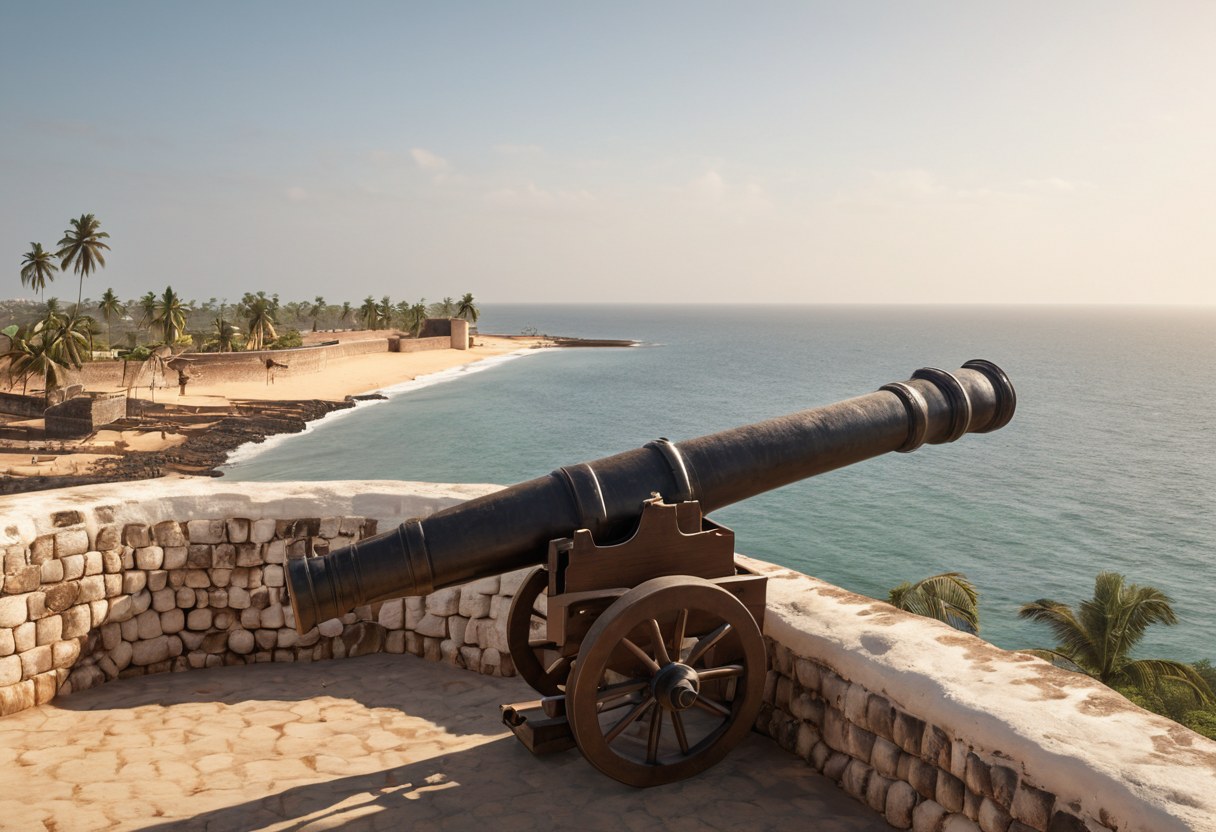
The Dutch fort was built in 1649. Its name — "heartbreak" — is generally taken as a comment on the difficulty of the undertaking, whether the cost, the climate or the resistance encountered. It was a modest square work compared with Elmina, sited close to the water with its guns commanding the landing.
Why Accra Mattered
Accra lay at the seaward end of routes running north into the Akwamu country and beyond, and it was a natural outlet for a hinterland the western forts could not reach. In the seventeenth century the powerful state of Akwamu dominated the region; in the eighteenth, Akyem and then Asante influence pressed down towards the coast. For a European post, the value of Accra lay in access to that trade — gold above all, and enslaved people, and later palm oil and other goods.
The competitive arrangement had consequences for the local Ga communities. Three forts meant three sets of customs payments, three sets of rents, and three European garrisons that could be played against one another. Ga leaders were not passive in this: the coastal towns grew up around the forts precisely because proximity to a European buyer was an asset worth living beside.
Life at the Fort
Fort Crèvecoeur was never large. A commander, a handful of company officials, a garrison of European soldiers reduced constantly by fever, and a much larger body of African employees, artisans, canoemen and interpreters, who did most of the work and knew most of what was happening. Around it grew Dutch Accra, a town of traders, brokers and Euro-African families.
- The fort stored goods between the arrival of ships and the sailing of the next.
- It gave the flag under which Dutch merchants traded and the guns that protected the anchorage.
- It housed the accounts, the correspondence and the small daily administration on which the company depended.
- Like the other Accra forts, it held enslaved people awaiting shipment during the era of the Atlantic trade.
1868: A Change of Flag
Under the Anglo-Dutch exchange agreed in 1867 and implemented at the beginning of 1868, the Netherlands gave up its posts east of Elmina in return for British posts to the west. Fort Crèvecoeur passed to Britain. It was renamed Ussher Fort, after Herbert Ussher, then the senior British official on the Gold Coast, and Dutch Accra came to an end as a separate jurisdiction after nearly 220 years.
The exchange was intended to rationalise a messy map. In practice it provoked serious resistance elsewhere on the coast, since communities were transferred between powers without being consulted, and it contributed to the sequence of events that led the Netherlands to withdraw from West Africa altogether four years later.
Afterlife
The British put the fort to a use the Dutch had not intended: for much of the colonial period it served as a prison. That role, more than its trading past, is what many Ghanaians associate with the building, and it gave the site a second layer of political history in the decades before independence.
Ussher Fort still stands in the old quarter of Accra, near James Fort, in the district that grew from the English town. It has been restored and used as a museum and heritage site, and it forms part of the recognised group of European forts and castles along the Ghanaian coast.
Reading the Site
What makes Fort Crèvecoeur worth attention is not architectural distinction but position. Standing on its walls one can grasp the whole logic of the coast: several European powers crowded onto the same beach, none of them sovereign over the country behind, all of them dependent on African states for trade, food and permission to stay. Modern Accra — the capital of Ghana, a city of millions — grew out of exactly that arrangement.