Elmina Was the Exception
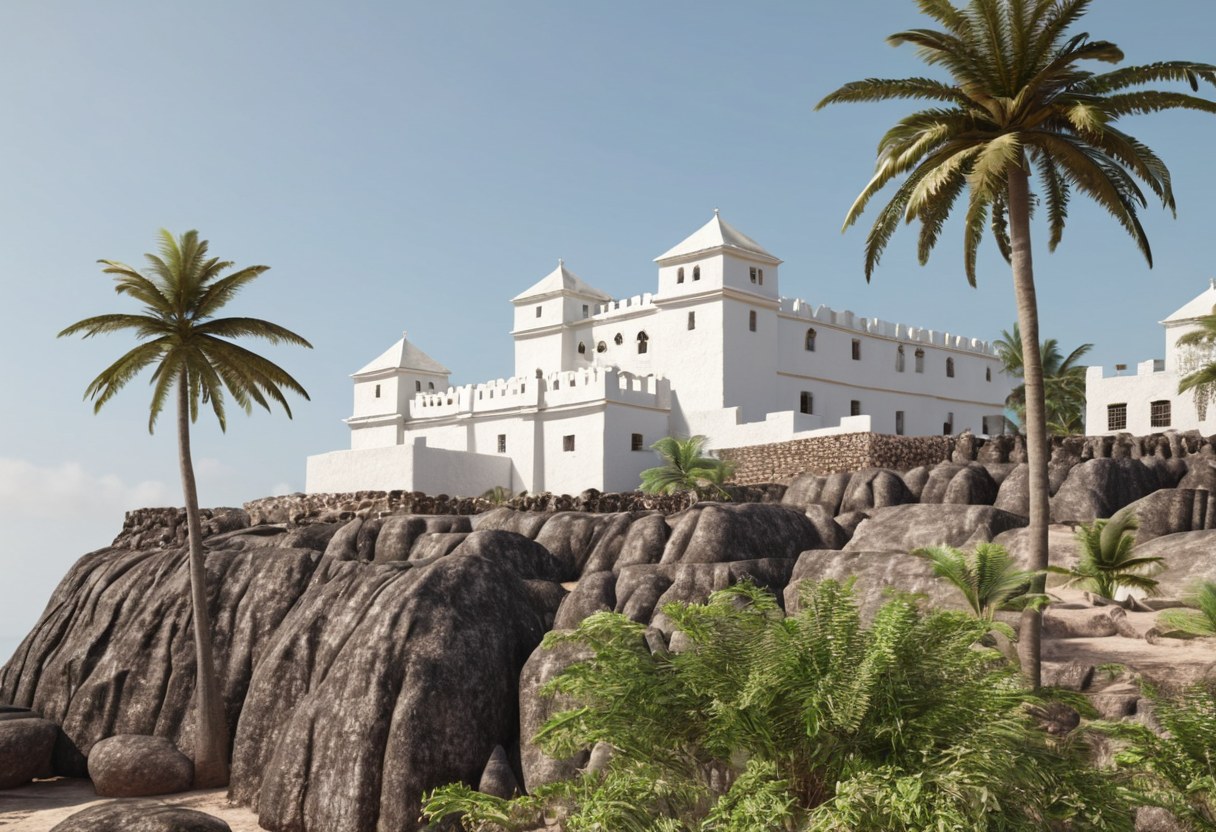
Elmina Castle is so large, so photographed and so central to the history of the Atlantic trade that it distorts the picture. It was not typical. The ordinary Dutch establishment on the Gold Coast was a small stone work with a handful of guns, a commander who was often the only European in reasonable health, and a warehouse. There were more than a dozen such posts, and understanding them is the surest way to understand what the Dutch presence really amounted to.
Fort Batenstein at Butri
Batenstein was built at Butri, in the Ahanta country west of Takoradi, in 1656. What makes it historically important is not the fort but the agreement that produced it. In August of that year the Dutch concluded a treaty with the authorities of Butre which placed the district under Dutch protection while leaving internal government in Ahanta hands. It was never repudiated by either party and remained formally in force until the Netherlands left the coast in 1872 — a span of more than two centuries, which makes it one of the longest-lived treaties of its kind anywhere.
That longevity is instructive. It survived because it suited both sides: the Dutch gained a secure station and a share of local trade, the Ahanta of Butre gained a European ally and a check on their neighbours. It was not an instrument of conquest, and for most of its existence it was barely an instrument of administration.
The Western Chain
Shama
Fort Sebastian stands at the mouth of the Pra, on a site first used by the Portuguese. The Dutch took it over in the seventeenth century and rebuilt it. Its position at a river mouth gave it access to canoe traffic from inland.
Axim
Axim, in the far west, was taken from the Portuguese in 1642. Its principal fort, St Anthony, became one of the more substantial Dutch stations and the centre of trade in the gold-bearing country of Nzema; a smaller work associated with the town is also recorded in the Dutch sources under the name Witsen. Axim's gold made it valuable long after the Atlantic trade had ended.
Sekondi
Fort Orange at Sekondi faced an English fort in the same town — the familiar pattern of paired European posts competing for the same suppliers, with the local community as the beneficiary of the competition.
Senya Beraku
Fort Goede Hoop, east of Elmina, began as a lodge in the late seventeenth century and was enlarged into a fort in the eighteenth, when demand for captives on the Atlantic market made a small station on that stretch of coast worth fortifying. It is one of the better-preserved of the smaller forts.
Others
Fort Amsterdam at Kormantin, taken from the English in the 1660s, Fort Nassau at Mouri, Fort Vredenburgh at Komenda, Fort Lijdzaamheid at Apam and several minor redoubts completed the network at various times. Few were held continuously; forts were captured, exchanged, abandoned and reoccupied as European wars and local politics dictated.
What the Scale Tells Us
A chain of small forts with tiny garrisons could not control territory, and did not try to. The Dutch on the Gold Coast were not administering a colony in any nineteenth-century sense. They were operating a commercial network on ground they occupied by agreement, at the sufferance of the states around them, and their military weakness was structural: European soldiers died of disease at a rate that made large garrisons impossible to sustain.
This has a direct bearing on the Asante relationship. A power that could not defend its own outposts against a serious African army had to negotiate, pay and keep on good terms. That is why the Dutch dealt with Kumasi by embassy and treaty, why payments such as the Elmina Note were made, and why the relationship lasted as long as it did.
Visiting Them Today
Most of the lesser forts survive in some form, from well-maintained monuments to overgrown ruins on headlands. They receive a fraction of the visitors that Elmina and Cape Coast do. For anyone trying to picture the Dutch Gold Coast as it actually was — thinly held, commercially driven, dependent on African goodwill — they are more instructive than the great castles.