Why Conservation Is a Historical Question
Objects survive because someone decided they should and paid for the conditions that made it possible. The distribution of Asante material culture across the world today is partly a story of collecting, and partly a story of who could afford air conditioning. Understanding conservation is therefore not a technical footnote to the history — it explains what has come down to us and shapes every argument about where objects should live.
Textiles
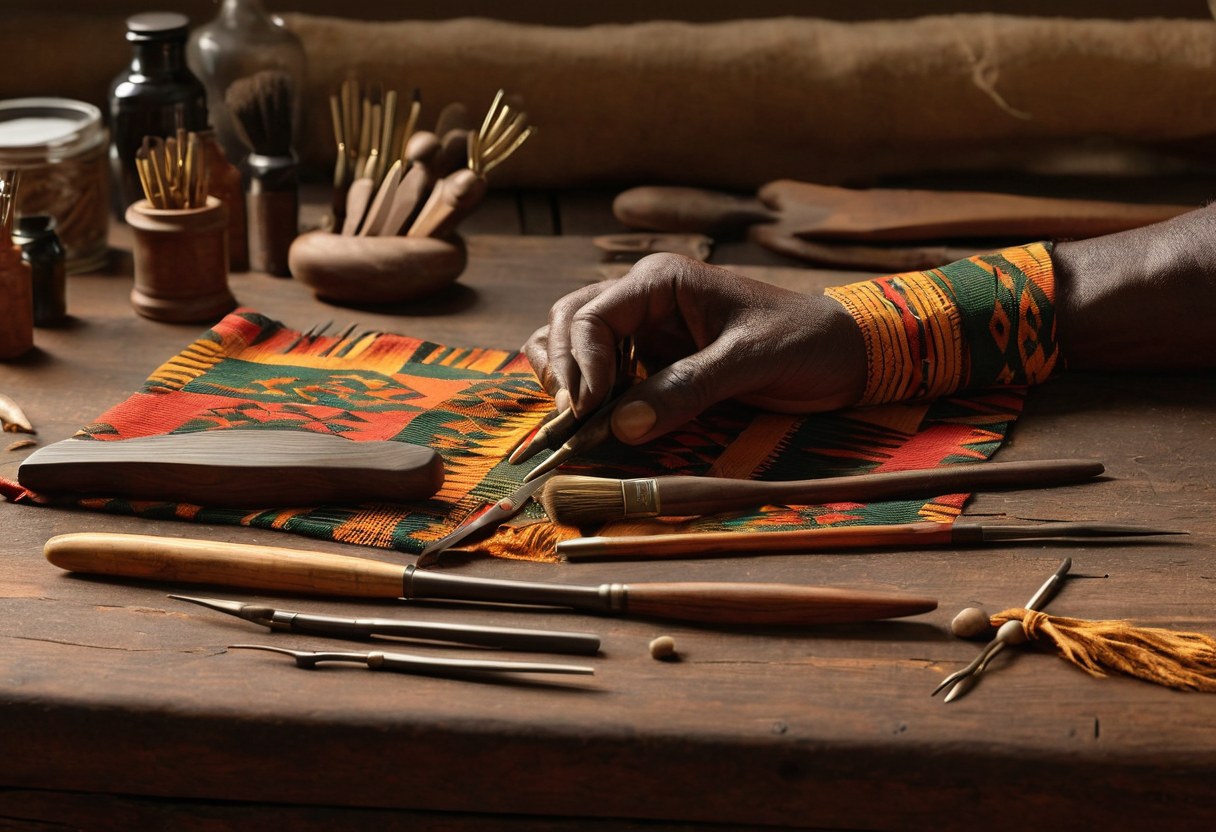
Kente and adinkra cloth are the most vulnerable category. Silk and cotton are organic, they are dyed, and both fibre and colour degrade under conditions that seem harmless.
- Light is cumulative and irreversible. Fading and fibre weakening from light exposure cannot be undone, which is why textiles are displayed at low light levels and are rotated off display for long rest periods. Visitors sometimes complain that textile galleries are dim; that dimness is the reason the cloth still exists.
- Humidity must be stable rather than merely low. Fluctuation is more damaging than a steady moderate level, because fibres swell and contract and the stresses accumulate, particularly where a cloth is made of strips sewn together with different tensions.
- Support matters more than anything. Historic cloth should be stored flat or rolled on a padded tube, never folded on a permanent crease and never hung by its own weight from a few points. Most catastrophic textile damage is mechanical, not chemical.
- Pests eat protein. Moths and carpet beetles attack silk and wool. Monitoring traps and clean storage do more than any treatment.
Gold, Gilding and Metalwork
Asante goldwork covers two quite different conservation problems, and the distinction is often misunderstood.
Solid gold
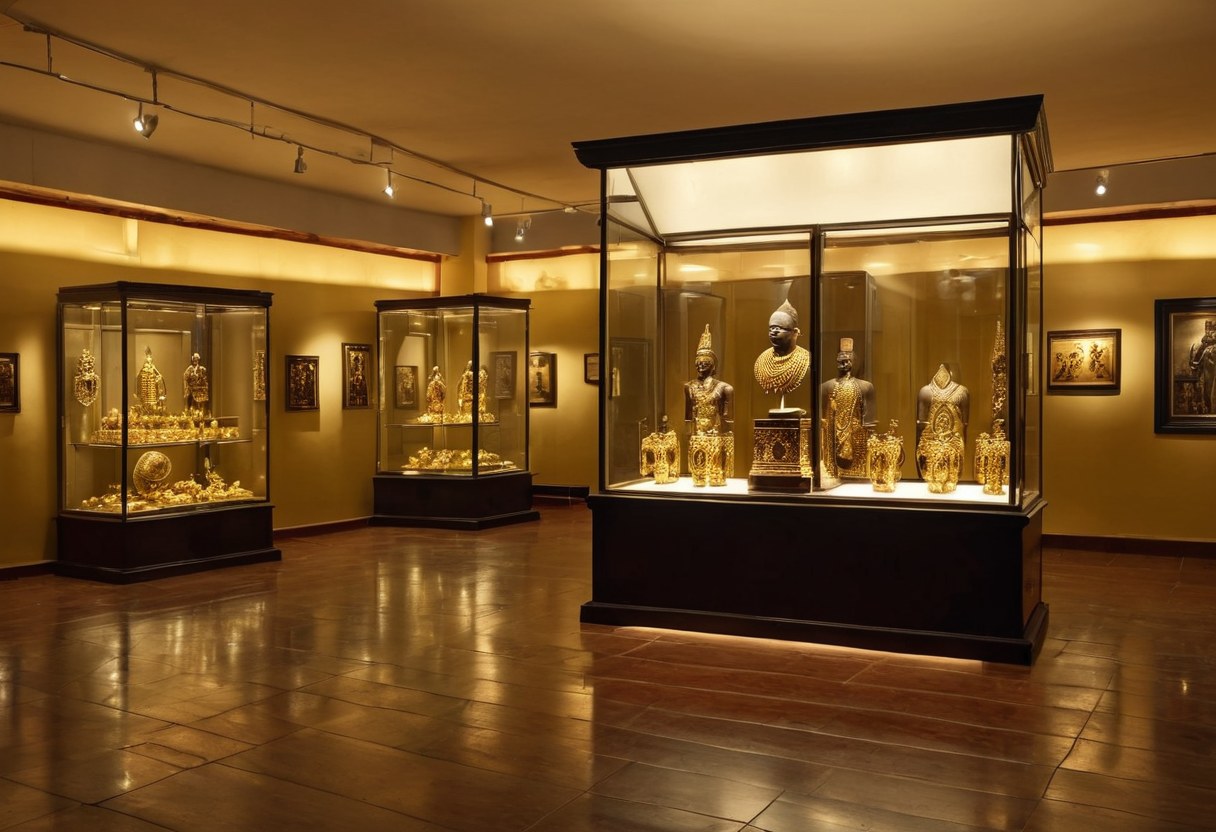
Pure gold does not corrode, which is why cast ornaments survive from the eighteenth century in essentially their original state. The risks are mechanical: bending of thin cast elements, abrasion from handling, and loss of the surface finish that a goldsmith intended. Objects that are alloyed with silver or copper, which many are, will tarnish and can corrode, so the assumption that "gold needs no care" is wrong in practice.
Gold-leafed wood
Much of what looks like solid gold in Asante regalia — umbrella finials, staff heads, sword handles — is thin gold leaf applied over carved wood. Here the metal is the least of the problem. The wooden core moves with humidity, the adhesive layer beneath the leaf ages and loses grip, and the leaf lifts, cracks and is lost. These objects are extremely sensitive to handling: a thumb pressed on a gilded surface can remove leaf permanently. Conservation focuses on stabilising the substrate and the adhesive layer, and on preventing contact altogether.
Brass and copper alloy
Gold weights, kuduo vessels and cast brass corrode in the presence of moisture and chlorides. Active corrosion has to be identified and halted; stable patina is generally left alone, because it is part of the object's history.
Wood and Stools
Carved stools, drums and figures face two enemies. The first is insects — powderpost beetles and termites can reduce a stool to a shell while leaving the surface looking sound. Modern practice treats infestation by controlled freezing or by anoxic treatment in a sealed low-oxygen enclosure, rather than by the chemical pesticides used through most of the twentieth century. The second is dimensional movement: wood shrinks and swells with humidity, and a carved object with joined or applied elements will crack, and lose gilding and inlay, if the environment is unstable.
A related issue affects historic collections everywhere. Ethnographic objects held in Western museums were frequently treated in the past with arsenic, mercury compounds and other pesticides. Residues persist, they are a health risk to anyone handling the objects, and they are a serious complication for returns: an object going home to be used ceremonially may need testing and, where possible, mitigation first. This is now a standard part of restitution planning.
The Tropical Problem
Institutions in Ghana face conditions that European museums do not: high and variable humidity, high temperatures, an active insect population and the cost and unreliability of continuous climate control. The answer is rarely to import a European specification wholesale. Passive approaches — building design, shading, ventilation, sealed display cases with buffering material, rigorous integrated pest management — are more sustainable than an air conditioning plant that fails during a power cut and produces exactly the humidity swing that does the damage.
Working Together
Conservation is one of the areas where Ghanaian and Dutch institutions have found the most practical common ground. Museums with colonial-era collections have a clear interest in supporting the training and facilities of institutions in the countries the objects came from, and collaborative projects have covered conservator training, condition surveys, storage improvement and the technical study of materials and manufacture. The 2024 arrival of returned and loaned regalia at the Manhyia Palace Museum made these arrangements concrete: a receiving institution has to demonstrate that it can care for what it takes back, and support for that capacity is now a normal part of the negotiation.
What Conservation Cannot Decide
A final point that is easy to miss. Conservation asks how to slow deterioration; it does not, by itself, answer what an object is for. A stool that is conserved in a case and a stool that is used in ceremony are being preserved in different senses, and the second may involve wear the first would prevent. Where objects return to living use, the conversation about care has to include the community that will use them, and the standard is not always the museum standard.