A Town and a Cloth
Bonwire lies a short distance north-east of Kumasi, and its name is bound up with kente more tightly than that of any other place. Weaving is the town's identity, its principal industry and its claim on Asante history. Visitors to the Ashanti Region are routinely taken there, and the looms working under shelters along the road are as much a part of the settlement as its houses.
Bonwire's primacy is real but not exclusive. Adanwomase and other nearby towns weave, and have their own claims to antiquity. Kente-type narrow-strip weaving is also practised by the Ewe of the Volta Region, whose kete tradition is distinct in patterning and iconography and is not derived from the Asante one. Origin stories attached to particular towns are part of a competition for standing that continues today, and they should be read as such.
The Loom
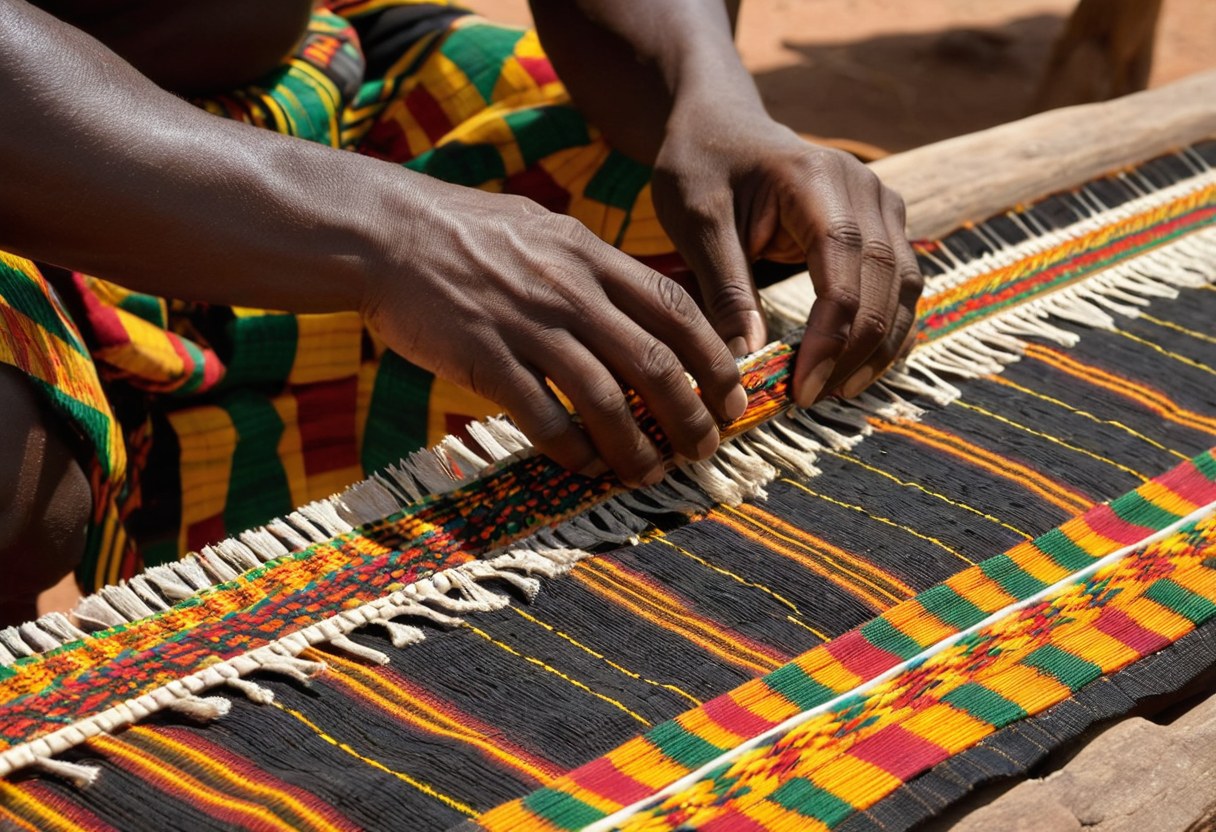
Kente is woven on a horizontal, double-heddle loom. The warp is stretched out across the ground in front of the weaver — sometimes many metres of it — and kept under tension by a weighted sled that is dragged forward as the work advances. The weaver sits at the loom, working the heddles with foot pedals and passing the shuttle by hand.
The critical feature is the double heddle, which allows two different sheds and therefore two structures in one cloth: a plain weft-faced ground, and blocks of supplementary weft that produce the dense coloured designs. Alternating between them is what gives kente its characteristic sequence of stripes and solid patterned blocks.
The strips produced are narrow — a hand's breadth or so — and are cut into lengths and sewn edge to edge to make a cloth. Matching the pattern across a dozen or more strips so that the design reads correctly across the finished piece is a large part of the skill.
Learning It
Training is by apprenticeship, traditionally beginning in childhood within the family. A boy starts by winding bobbins and preparing warps, moves to weaving plain strips, and only later attempts patterned work. Mastery is measured by the number of named designs a weaver can execute from memory and by the evenness of the cloth. The apprenticeship is long and its structure has been remarkably stable.
Patterns and Their Names
Kente designs are named, and the names carry meaning: proverbs, historical references, the names of rulers, qualities such as skill or wealth. A weaver does not simply produce a colourful cloth but executes a specific, recognised design that an informed viewer can identify and interpret. Colour carries meaning too — gold with royalty and wealth, green with growth, black with mourning and with the ancestors — though these associations are conventions rather than a fixed code, and they are read in context.
Historically, certain designs were reserved. The most elaborate patterns were made for the Asantehene and the court, and a cloth might be woven for a single person and its design not repeated. Sumptuary restriction of this kind was part of how regalia worked across Asante material culture: what you were entitled to wear stated your position. Those restrictions have loosened considerably, and today the constraint is mainly cost.
Materials
Early kente used cotton, which was locally grown and spun. Silk entered the tradition through the coastal trade: imported silk cloth was unravelled thread by thread and rewoven into kente, an expensive and laborious practice that produced the brilliant colours associated with the best cloths. Later, imported silk and then rayon and other synthetic yarns replaced it. A modern high-quality cloth may be cotton, rayon, silk or a mixture, and the choice of yarn is a large part of what determines price.
The Craft Today
Bonwire's weavers now work for several markets at once: Ghanaian customers commissioning cloth for weddings, funerals and festivals; the diaspora; tourists; and the international market for kente-patterned goods. The last of these is the most double-edged. Kente motifs are printed by the roll on cloth made in factories in and outside Ghana, and printed imitation competes directly with hand-woven cloth that takes weeks to make.
Weavers and Ghanaian institutions have responded with authentication schemes, cooperatives and attempts to have the tradition formally protected. The underlying tension is familiar wherever a hand craft has become a global visual motif: the pattern travels easily and the labour does not. What sustains Bonwire is that for the occasions that matter most in Asante life, a printed cloth is not accepted as the same thing.