Not Only the Golden Stool
The Golden Stool, the Sika Dwa Kofi, is the best-known object in Asante culture: the shrine of the nation's soul, which by tradition descended from the sky at the founding of the union and which no person, including the Asantehene, has ever sat upon. Its fame is deserved, but it can obscure something more fundamental. The Golden Stool is extraordinary because of what ordinary stools already are.
In Asante thought a stool — dwa — is not furniture. It is closely bound to the person who owns it, and through that person to their lineage and to the office they hold. Understanding this makes sense of a great deal that otherwise looks like ceremony for its own sake.
The Personal Stool
A person of standing acquires a stool, often given at a life-stage ceremony. It becomes theirs in a strong sense: it is not casually lent, not sat on by others without reason, and is kept in a particular way — traditionally laid on its side when not in use, so that no wandering spirit takes the seat. The stool absorbs something of the owner over a lifetime, and the relationship between person and stool is close enough that Asante speak of the stool as containing or supporting the owner's soul, the sunsum.
Stools are carved from a single block of wood, usually a pale hardwood, in a standard form: a curved seat, a flat base, and a central support with two or four flanking columns. The support is where the design lives. Its shape may be geometric or figurative, and it frequently refers to a proverb — a leopard, a knot, a rainbow, an elephant — so that a stool states something about its owner just as a linguist's staff or a cloth pattern does.
Blackened Stools
When an important person dies, the stool may be blackened and preserved. The blackening is done with a mixture that has included soot, egg and sacrificial blood, applied over time, giving the surface its dark, encrusted appearance. The stool then ceases to be an object of use and becomes an ancestral shrine.
Blackened stools are kept together in a stool room, in the palace of a chief or the house of a lineage head. This room is the ritual centre of the office. Offerings are made there at appointed times, particularly during Adae and Odwira, and it is here that a chief communicates with his predecessors. The stools are arranged as a line of office holders, which makes the stool room a physical record of succession — the ancestors are present, in order, and can be addressed.
Not every dead person's stool is blackened. The honour belongs to those who held office and whose conduct in it merits continued veneration; a ruler removed in disgrace may be denied it. In this way the practice functions as a posthumous judgement as well as a memorial.
Enstoolment and Destoolment
Because office is bound to the stool, Asante political vocabulary is built on it. A chief is not crowned but enstooled; he is not deposed but destooled. The candidate is nominated by the queen mother from the eligible members of the royal matrilineage, considered by the elders and the constituency, and installed in a ceremony whose central act is being lowered three times onto the ancestral stool.
The corollary matters as much. A stool is not owned by the person who occupies it. It belongs to the lineage and to the community, and the occupant holds it on conditions. If he breaks them — abuse of office, neglect of the ancestors, failure to consult — the elders may destool him, and this was a real and used power rather than a theoretical one. Asante chieftaincy was accountable in a structural way, and destoolment was its mechanism.
The Golden Stool in Context
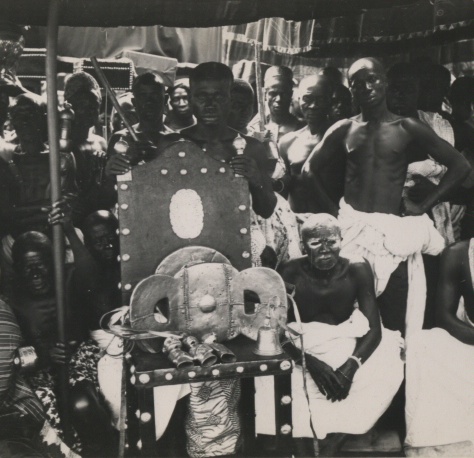
Placed in this framework, the Golden Stool is legible. Tradition attributes its arrival to Okomfo Anokye at the founding of the Asante union around 1700, when it is said to have descended and to have contained the soul of the nation. It is not the Asantehene's personal stool and not a throne; it represents the whole people, and the Asantehene is its custodian.
This explains the events of 1900, when the British governor Frederick Hodgson demanded to sit on the Golden Stool. The demand was not a breach of etiquette but an assault on the soul of the nation, and the war of resistance led by Yaa Asantewaa followed. The stool itself was hidden and was not surrendered. Nothing in that episode makes sense unless one understands what a stool is.