What Provenance Research Is
Provenance is the documented history of an object's ownership from the moment it was made to the present. Provenance research reconstructs that chain, and where the chain is broken it tries to establish how and why. For colonial-era collections the question is rarely who owned an object in 1950; it is how it left the society that made it, and whether the people who parted with it had any meaningful choice.
The Documentary Trail for Asante Objects
For objects removed from Kumasi in the nineteenth century the evidence usually runs through four kinds of record.
- Military and campaign records. Expedition despatches, prize agents' papers and officers' accounts from the 1874 campaign and from 1896 record what was taken and by whom.
- Auction and dealer records. A large quantity of the gold taken from Kumasi in 1874 was sold at auction in London that year. Sale catalogues, dealers' stock books and buyers' names are frequently the pivot on which an object's history turns.
- Museum registers. Accession registers record the date an object entered a collection and the name of the donor or vendor, and often little else. The register entry is the anchor, and the work is establishing what happened before it.
- Family papers and photographs. Objects that passed through private hands for a century often carry a family story, sometimes accurate, sometimes embellished, which has to be tested against the other records.
Dutch collections present a different picture. Because the Netherlands left the coast in 1872, before the conquest of Asante, most Dutch-held Asante material arrived through trade, gift or later ethnographic collecting rather than through military seizure. That does not settle the question — collecting under colonial conditions raises its own issues of consent and inequality — but it means the analysis is less about a single documented event and more about the circumstances of ordinary acquisition.
Dutch Policy on Colonial Collections
The Netherlands has moved further than most European states in setting out a formal position. An advisory committee reporting in 2020 recommended that objects taken involuntarily from former colonies should be returned unconditionally when the country of origin requests them, treating the matter as one of recognising injustice rather than of goodwill. The government accepted the principle, and a committee on colonial collections was established to assess claims and advise the responsible minister.
Under this framework the Netherlands has returned objects to several countries. Claims are made state to state; the assessment turns on whether the object was taken involuntarily and on the quality of the provenance evidence; and the outcome is a ministerial decision on the committee's advice. Dutch museums have in parallel invested heavily in provenance research on their own holdings and increasingly publish the results in their online catalogues.
For Asante material specifically the position is still developing. Research on Dutch West African holdings continues, and readers should treat any statement about what has or has not been returned as a snapshot; this is an area where the situation genuinely changes.
The British Cases and the Loan Question
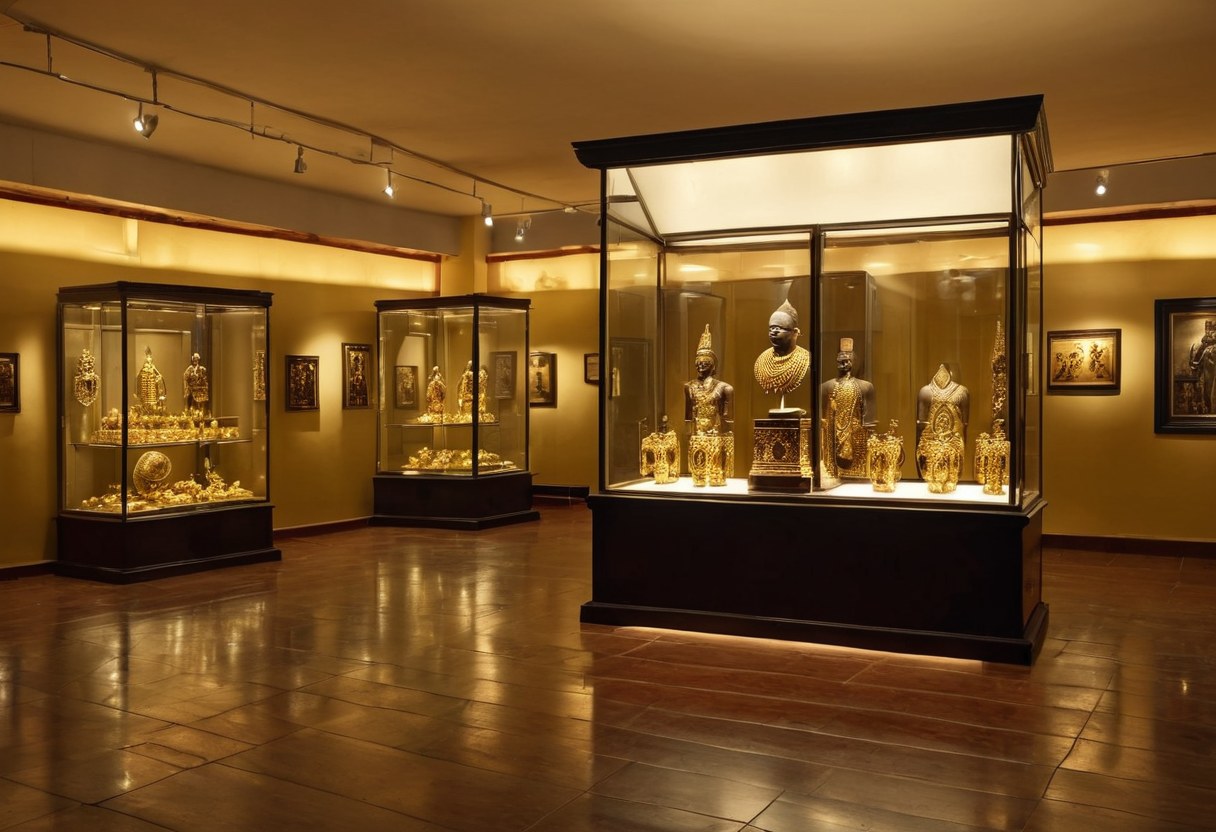
Britain holds the bulk of the material taken in 1874, and British policy is more constrained. Legislation governing the national museums restricts their ability to dispose of objects permanently, which is why the arrangements announced in 2024 for gold regalia to be displayed at the Manhyia Palace Museum took the form of long-term renewable loans rather than transfers of ownership. Reactions to that model divide sharply. Supporters point out that it puts objects back in Kumasi now, within an existing legal framework. Critics observe that it requires the dispossessed party to borrow its own property and leaves the underlying claim untouched. In the same period a United States university museum transferred ownership of Asante royal items outright, which sharpened the contrast.
The Arguments in Play
- Legal title versus moral claim. Museums generally hold clear title under the law of their own country. The question is whether title acquired through conquest or in its immediate aftermath should be treated as legitimate.
- Who is the claimant. Asante regalia belongs to the Golden Stool and the Asante state, but international restitution processes run between national governments. In Ghana this requires the national government and Manhyia to act together, which they have done, but the structural mismatch is real.
- Care and access. The argument that objects are safer or more widely seen in Europe has weakened considerably as Ghanaian institutions have improved, and it has always sat awkwardly beside the fact that the objects were taken by force.
- Precedent. Institutions worry that one return implies many. Advocates reply that this is an argument about administrative convenience, not about justice.
What Remains Unresolved
Three things in particular. The scale of what is held is still not fully known, because much material in smaller and private collections has never been researched. The legal obstacles in some jurisdictions have not been removed, only worked around. And there is no settled answer to what should happen to objects acquired in ways that were not violent but were not equal either — the largest category by far, and the one where Dutch collections mostly sit. Provenance research is the necessary groundwork for all three: without a documented history, neither a claim nor a defence can be assessed at all.