Before the Fort
Dutch ships had been working the Gold Coast since the closing years of the sixteenth century, buying gold and ivory from the beach and from small unfortified lodges. It was an exposed way to trade. The Portuguese, who had held Elmina since 1482 and claimed the whole coast as theirs by papal grant, regarded the newcomers as interlopers and attacked their vessels and shore parties when they could.
What the Dutch needed was a defensible place of their own — a walled store where goods could be kept between ships, and guns to keep the Portuguese at a distance. They found it at Mouri, a coastal town a short distance east of what is now Cape Coast, whose ruler belonged to the state of Asebu.
Building Fort Nassau, 1612
Agreement with the Asebu authorities was reached and construction began in 1612. The fort was named after Maurits of Nassau, Prince of Orange and the leading soldier of the Dutch Republic; it was the first permanent Dutch fortification anywhere in West Africa, and for a quarter of a century the headquarters of Dutch operations on the coast.
The site was chosen for practical reasons rather than grandeur. It stood on rising ground close to a landing place, with a field of fire over the approaches and enough space to hold trade goods, a garrison and provisions. Successive rebuildings enlarged and strengthened it, and after the founding of the West India Company in 1621 it became a company station.
Breaking the Portuguese Monopoly
Fort Nassau's importance was strategic out of all proportion to its size. It gave the Dutch a permanent, armed presence on a coast the Portuguese claimed exclusively, and it demonstrated to African rulers that Portugal could be dealt with as one European power among several rather than as the gatekeeper of all seaborne trade. Asebu and its neighbours gained a competing buyer for their gold, and used the competition.
The fort was also a base for operations against Elmina itself. A Dutch attempt on the great Portuguese castle in 1625 was mounted from this stretch of coast and failed badly. The second attempt, in 1637, succeeded: Elmina fell, and with it the centre of gravity of the entire Dutch enterprise in West Africa.
Decline
Elmina was everything Mouri was not — larger, stronger, deep in the gold trade and with a substantial town attached. The Dutch administration moved there, and Fort Nassau became a secondary post. It kept a small garrison and a modest trade through the later seventeenth and eighteenth centuries, but its best years were behind it.
Like every fort on the coast it was drawn into the wars of the European powers, changing hands during the Anglo-Dutch conflicts of the period. By the nineteenth century it was militarily and commercially irrelevant, and it fell out of use. When the Netherlands transferred its Gold Coast possessions to Britain in 1872, Fort Nassau was long past the point of mattering.
What Survives
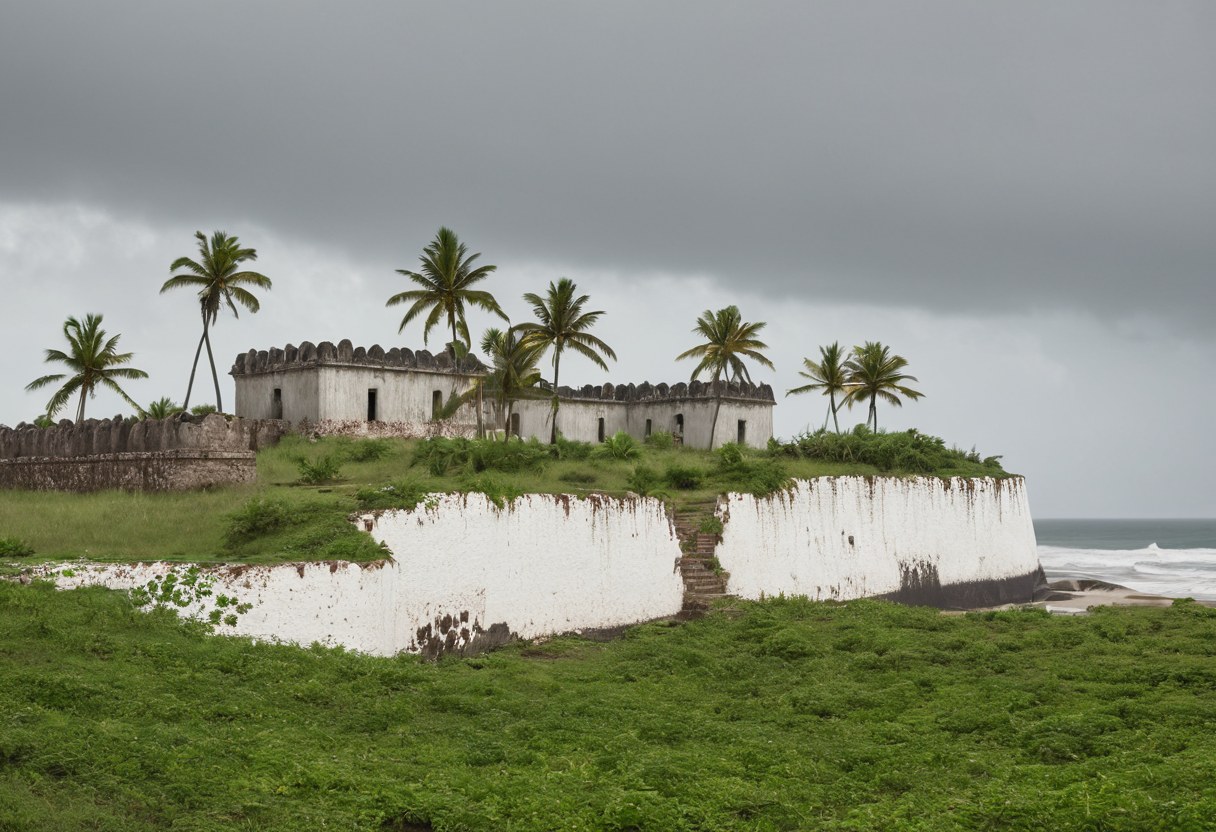
Substantial ruins remain on the headland at Mouri: sections of wall and bastion, foundations, and the outline of the enclosure, weathered by four centuries of salt air. The site is part of the wider network of European forts along the Ghanaian coast, most of which are protected as national monuments and collectively recognised for their international significance.
It is a quiet place, visited far less than Elmina or Cape Coast, and that is part of its value. The great castles are so overwhelming that they can obscure how the trade actually began — not with monumental architecture but with a modest walled post on a hill, built by permission of a local ruler who calculated that a second European buyer would be useful.
Why It Matters
Fort Nassau marks the beginning of the Dutch presence that would last 260 years and that eventually brought the Netherlands into direct relations with the Asante kingdom. Everything that followed — Elmina, the treaties, the Elmina Note, the recruitment of the Belanda Hitam — depended on the foothold established at Mouri in 1612. It also records something easily forgotten: the Dutch did not arrive on this coast as conquerors of territory. They arrived as tenants, on terms negotiated with an African state that expected to profit from the arrangement.