The Grove
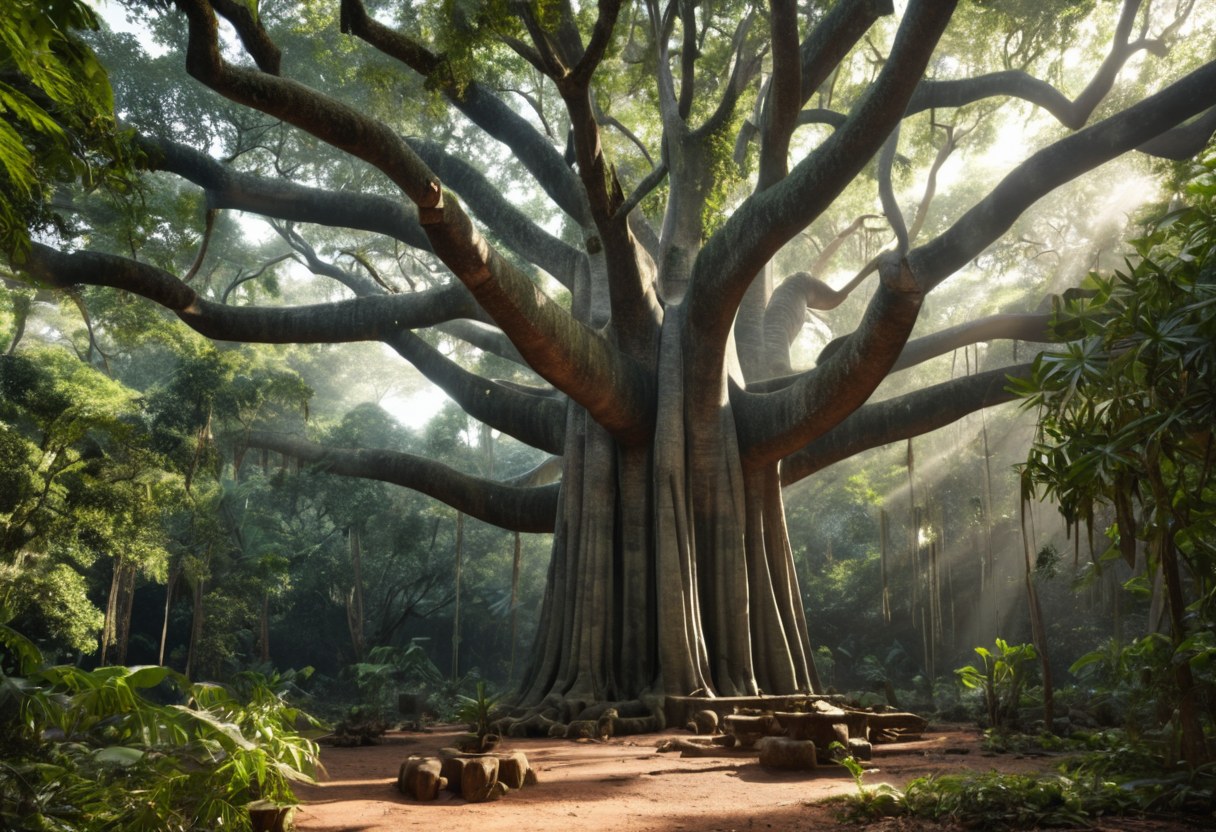
South of Kumasi, in the forest country of the Amansie district, lies Asantemanso: a grove of very old trees, kept from cultivation, quiet in a landscape otherwise given over to farms and villages. It has no monumental architecture and would be easy to walk past. It is, in Asante understanding, where the Asante people began.
The Tradition
The narrative preserved at Asantemanso is one of emergence. The ancestors of the Asante — in most versions the founders of the matrilineal clans, the abusua from which every Asante still traces descent — came up out of the earth at this place, and from here their descendants spread to found the towns that would eventually form the Asante union.
Related traditions attach to other sites, and there are variants in which particular groups descended from the sky or arrived from elsewhere. Such accounts should not be read as failed attempts at reportage. They are statements about relationship: which lineages belong to which clan, which towns are senior to which, and who therefore has a claim to which stool. In a political system built on descent and precedence, an origin narrative is a constitutional document.
What the Ground Says
Asantemanso has also been excavated. Archaeological work in the area, most extensively in the 1980s and 1990s, recovered a long sequence of occupation debris — pottery, evidence of iron working, food remains and traces of settlement — with the earliest radiocarbon dates running back well over a thousand years, into the first millennium AD.
This is a striking result. The Asante state was founded in the late seventeenth century; the site of its traditional origin was inhabited for the better part of a millennium before that. Whatever one makes of the emergence narrative, the claim that Asantemanso is an ancient centre of settlement in the forest is not a later invention. People were living, farming and working iron there when the forest was supposed, in some older European accounts, to have been empty.
The excavations also bear on a broader question. It was long argued that the forest zone was settled comparatively late, and that Akan society was formed by migration from the savanna. Evidence of deep, continuous occupation at sites such as this one supports a different picture: a forest population of long standing, developing in place, with the states of the seventeenth century as the culmination of a long local history rather than the product of a recent arrival.
Tradition and Evidence
It is worth being careful about what the archaeology does and does not do. It cannot confirm that the clan ancestors emerged from the ground; that is not the kind of claim excavation can address. It cannot date the founding of particular lineages or verify a king list.
What it can do is establish that the place in the narrative is a real place with a real and very long history of habitation, and that the tradition is anchored to a site that mattered long before anyone had reason to invent a story about it. Oral tradition and archaeology are answering different questions, and the honest reading holds both without collapsing one into the other.
A Living Site
Asantemanso is not a ruin. It remains a sacred place, with observances maintained by the community that holds it and with restrictions on what may be done in the grove — protections which, incidentally, have preserved a patch of old forest in a heavily farmed region. Its standing is acknowledged within the Asante state, and it forms part of the wider landscape of heritage sites in the Asante region.
Why It Matters
Political legitimacy in Asante has always run through origin. The Asantehene's authority, the ranking of the paramount stools, the relations between clans and the claims of towns to precedence are all argued in the language of who came from where and who came first. Asantemanso is the point to which those arguments return.
For a history that Europeans long insisted on beginning in 1471, when the first Portuguese ships reached this coast, the grove is also a corrective. The Asante account of themselves begins in the forest, centuries earlier, and the evidence in the ground supports the general shape of that claim.