Money You Could Pour
For most of the kingdom's history, Asante money was gold dust: sika futuro, the fine particles won from streams and from shallow workings in the forest. It was not coined, stamped or issued by any authority. Its value lay in its weight and its purity, which meant that every transaction of any size involved a weighing, and that the instruments of weighing were themselves objects of consequence.
This had practical advantages. Gold dust was divisible to almost any amount, it did not depend on a mint, and it was accepted from the coast to the northern markets. It also had a striking disadvantage: it was easy to adulterate, and disputes over the fineness of dust were a routine feature of trade. Traders carried their own weights and expected to check the other party's.
The Weights
The brass weights used to measure gold dust — abrammuo in Twi, and widely known in museums as Akan goldweights — are among the best-known objects of West African art. They were cast in brass by the lost-wax method, and they fall broadly into two groups.
Geometric weights
The earlier and more numerous type is geometric: pyramids, discs, cubes, stepped and swastika-like forms, incised with lines, chevrons and dots. Their surface patterning is not decoration alone; on many examples it appears to have functioned as a marking system distinguishing one denomination from another.
Figurative weights
The later type is figurative: birds, fish, antelope, sandals, drums, stools, guns, and small tableaux of human figures. Many of these refer directly to proverbs, so that the weight in a trader's bag carried a saying as well as a value. A common example is the bird looking backwards, associated with the idea that it is not wrong to go back for what you have forgotten. A weight of this kind was a moral object and a commercial instrument at the same time.
Scales, Spoons and Boxes
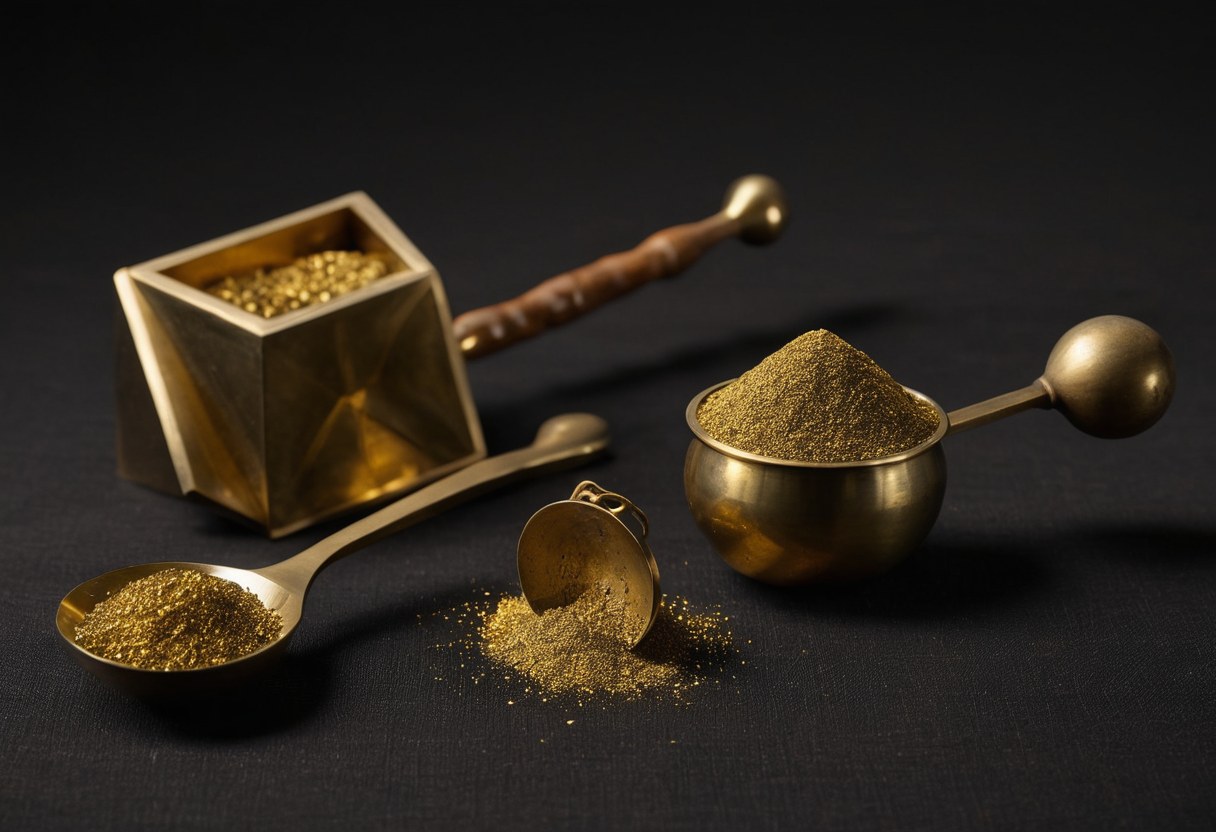
A complete set involved more than weights. It included a small balance with brass pans, spoons for lifting dust, a blowpan or sieve for cleaning it, and a container — often a cast brass kuduo or a sheet-brass forowa — for storing it. Such sets were personal, inherited, and in wealthy households substantial. Museums in Europe hold a great many of them, and the Dutch collections in particular acquired sets through Elmina.
Denominations and Their Limits
Asante gold-dust accounting used a series of named units, of which the peredwan was the largest in common use, made up of smaller units such as the damma and the taku. Converting these into modern equivalents is unrewarding: the relationship between them was not perfectly fixed across time or place, several regional standards were in use, and European visitors recorded the values inconsistently. What can be said with confidence is that the system was fine-grained enough for everyday market transactions and robust enough to handle state-level payments such as tribute and indemnities.
Cowrie shells circulated alongside gold dust, particularly in the northern trade towards Gonja, Dagomba and the savanna markets, where cowries were the ordinary small change. The two systems met and were exchanged against each other along the great roads.
Meeting European Money
On the coast, gold dust met European coinage and accounting. Dutch, English, Danish and Portuguese traders bought in gold and later in produce, and kept their books in their own currencies while paying and receiving in dust. The mark and the ounce of the European trade ledgers sat awkwardly on top of the Asante units, and a good part of the friction in coastal trade came from the translation between them.
Gold dust remained in use well into the colonial period, but did not survive it. British currency, colonial taxation and the growth of cocoa as an export commodity gradually displaced it, and by the early twentieth century weighing gold for everyday payment had ended. The weights survived as heirlooms and then as collectors' items, and the very large number of them now in European and North American museums is a direct consequence of that shift: once they stopped being money, they became art.
Studying the Weights
Serious study of the weight system was advanced considerably by Timothy Garrard, whose work on Akan gold weights and gold trade attempted to reconstruct the denominational standards from surviving sets rather than from European descriptions. Later scholars have qualified some of his conclusions, and the exact history of the standards remains an open question — one of those subjects where the objects are abundant and the documentation is thin.